
If you’re a parent of a primary school child and you’re worried about how your child is settling into their current or new class, here are some questions you can ask them to get a sense of the atmosphere in the classroom.
How to start the conversation (Primary school children)
Important: Don’t ask direct questions straight away, such as: ‘Is anyone bullying you?’
It’s better to start with something like this:
- What was the best thing that happened to you at school today? And what was the most unpleasant or bad thing?
- If you could choose who to sit next to, who would you pick? And who would you definitely not want to sit with? Why?
- What’s the strangest, funniest or most unpleasant word you’ve heard at school?
- Do the teachers ever say strange, funny or unpleasant things?
- What tires you out the most at school?
- If you had the chance to remove anyone from the class—or even a few people—who would you remove?
- If you became a teacher, what would you change about your school?
- Do you think all your marks are fair?
- When I say the word ‘classmates’, what’s the first thing that comes to mind?
Important: Listen carefully to what your child says (or doesn’t say). Their tone of voice, pauses, confidence or, conversely, confusion – all of these can be key to understanding their emotional state.
What should you do if their answers give you cause for concern?
- Stay in touch. Don’t pressure them or question them suspiciously; instead, make them feel that you are there for them and always ready to listen.
- Don’t dismiss their feelings. Phrases like ‘Oh, just put up with it’, ‘It’s like that everywhere’, or ‘It’s no big deal’ can cause them to withdraw into themselves. Instead, say: ‘I hear you. I want to sort this out with you.”
- Look out for changes in behaviour. Skipping school, complaining of stomach or head aches for no apparent reason, increased anxiety or irritability may be their way of telling you: “I’m not well.”
- Show that you’re ready to take action. If your child is facing bullying or unfair treatment, they need to know they can count on your support. Talking to the teacher, working with a counsellor, and finding solutions together with your child – all of this will help them feel safe.
The ‘Little People in the Tree’ method
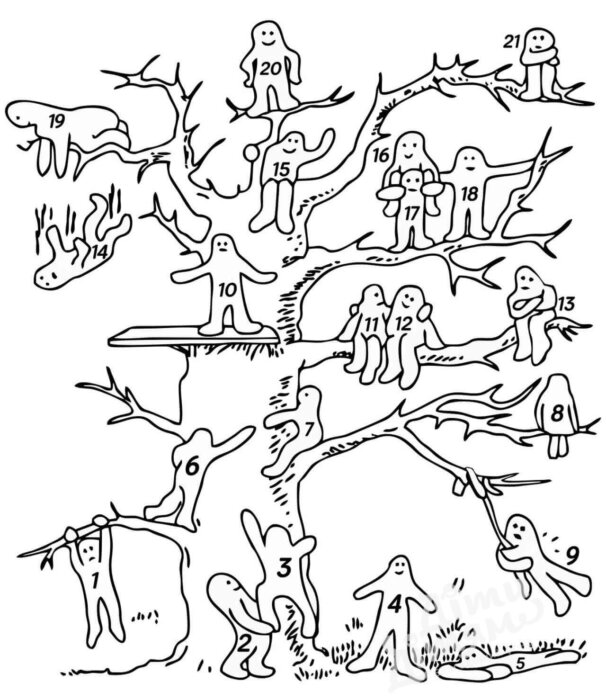
This simple method will help you understand how your child is doing, not only at school but also in various areas of their life, including:
- Their relationship with the group and how they are settling into a new class or group.
- Their relationship with significant adults.
- The nature of the parent-child relationship.
- Their self-esteem.
It all depends on the question you ask your child. Application for assessing their situation at school/in a group.
- Ask the child to look closely at the tree and the little people. Point out that each little person has their own mood.
- Ask the child which of these little people most resembles their mood at school?
- Suggest that they colour in the tree if they wish.
Additional questions for discussing their choice:
- How often do you feel like this?
- In which lessons?
- And how do you feel during break times?
- Is there anyone whose mood you’d like to have? If so, show us.
Interpretation of the child’s choices (example)
- 1, 3, 6, 7: The posture of a determined person who fears nothing – neither obstacles nor barriers in their path.
- 2, 11, 12, 18, 19: A sociable person, focused on helping friends and loved ones.
- 4: A stable outlook on life helps achieve high results in one’s endeavours, especially if no serious difficulties arise along the way.
- 5: Characterised by rapid fatigue and weakness due to a low reserve of energy and vitality. Shyness is present (it is important to understand the reasons behind this).
- 9: Simply a very cheerful person by nature, a lover of entertainment.
- 13, 21: Anxiety and introversion lead to a narrowing of social circles and reduced sociability.
- 8: Likes to immerse themselves in their own world, withdraw into themselves, daydream and reflect. There is a detachment from the learning process.
- 10, 15: Normal adaptation to one’s current life situation, complete comfort and contentment with the world around them.
- 14: Signs of an inner crisis, emotional problems, a sort of ‘falling into an abyss’.
- 20: A leader’s inflated self-esteem demands maximum attention from those around them for their own sake.
- 16: Tired of life and the need to support others, so receives support from person #17.
 And on the @anita_prof profile you’ll find more assessments, recommendations and useful practices to help you and your children live happy and fulfilling lives.
Pediatric Perinatal Psychologist and Art Therapist