
Practical Speech Development Tips for Parents
Why do some children happily talk about everything under the sun, while others answer in a single word? How can you teach a child not only to speak, but also to keep up a conversation, ask questions, express wishes, and share their own thoughts? And most importantly — what can parents do at home without turning communication into endless speech therapy sessions?

A child’s speech does not develop only during special sessions with a speech-language therapist. Many opportunities for it arise every day: at breakfast, while getting dressed, on the way to preschool, at the store, on a walk, during play, and even while tidying up toys.
There is, however, an important nuance: the number of words a child hears does not equal the quality of their language environment.
You can talk to a child all day and leave them almost no chance to answer. You can constantly ask questions and still never get a real conversation. You can ask them to repeat words and still not build a desire to communicate on their own.
Our goal is not simply to increase the number of words in a child’s speech, but to help them realize that speech is a way to influence the world around them, get help, share emotions, talk about their own experiences, and build relationships with other people.
Let’s look at specific techniques parents can use at home.
1. Connection first, speech second
Before expecting a spoken response from a child, it is important to create the conditions for interaction.
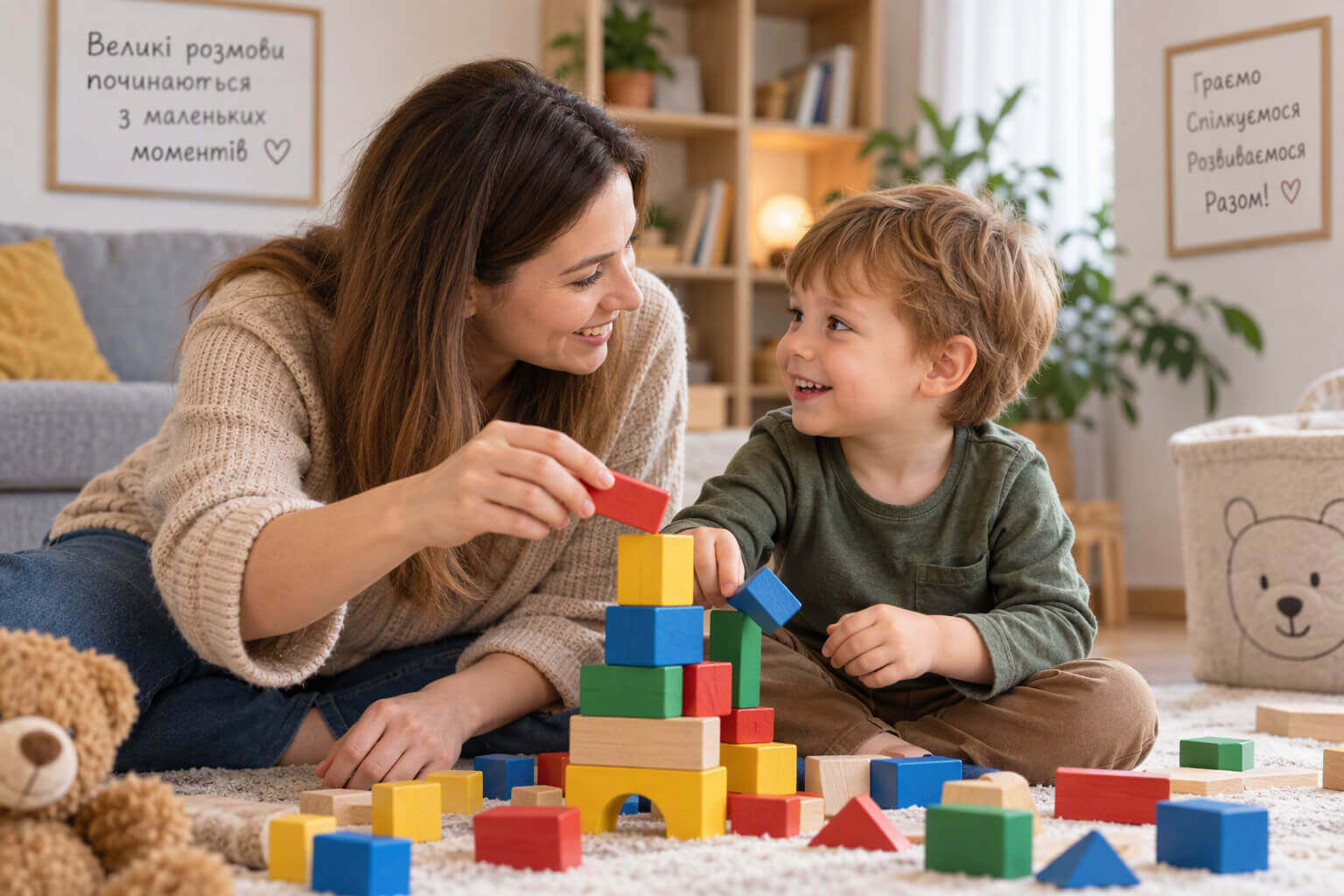
If a child is absorbed in building with blocks and an adult keeps asking: “What color is the block?”, “How many are there?”, “And what’s this?”, this kind of communication will most likely tire them quickly. Instead, you can sit down nearby, pick up a few blocks, and join the game.
The child builds a tower while the adult comments: “Wow, what a tall tower! One more block. Oops, it fell!”. Now you have a shared activity, emotions, and a natural reason to communicate.
What parents can do:
- Get down to your child’s level so they can comfortably see your face if they want to.
- Notice what your child is interested in right now.
- Join their play rather than rushing to change the storyline.
- Comment on what is happening in short, clear phrases.
- Use natural intonation, facial expressions, and gestures.
- Do not demand constant eye contact.
- Let your child suggest ideas and change the course of the game.
This approach is called following the child’s lead. It is widely used in modern early communication programs.
2. Learn to wait
Adults often talk too quickly and fill every pause.
For example:
— What do you want? Juice? Water? Milk? Come on, say it! Hurry up!
As a result, the child may not have time to process the information, form an answer, or show initiative.
Try a different approach:
— What would you like to drink?
The adult pauses.
The child looks at the cup.
— I see you’re looking at the cup. Would you like some water?
The adult waits again.
The child nods or answers.
It is important to understand: a spoken response does not always come instantly. Some children need more time to form it.
Practical tips:
- After asking a question, pause for about five seconds. If your child needs more time, wait longer.
- Do not answer for your child when they are trying to do it themselves.
- Do not repeat the same question many times in a row.
- Treat gestures, gaze, pointing, sounds, and words as possible ways of communicating.
- Do not make your child say a word before they can get the item they want or the help they need.
The purpose of a pause is to create room for initiative, not to add pressure.
3. Fewer questions, more comments
Imagine this situation.
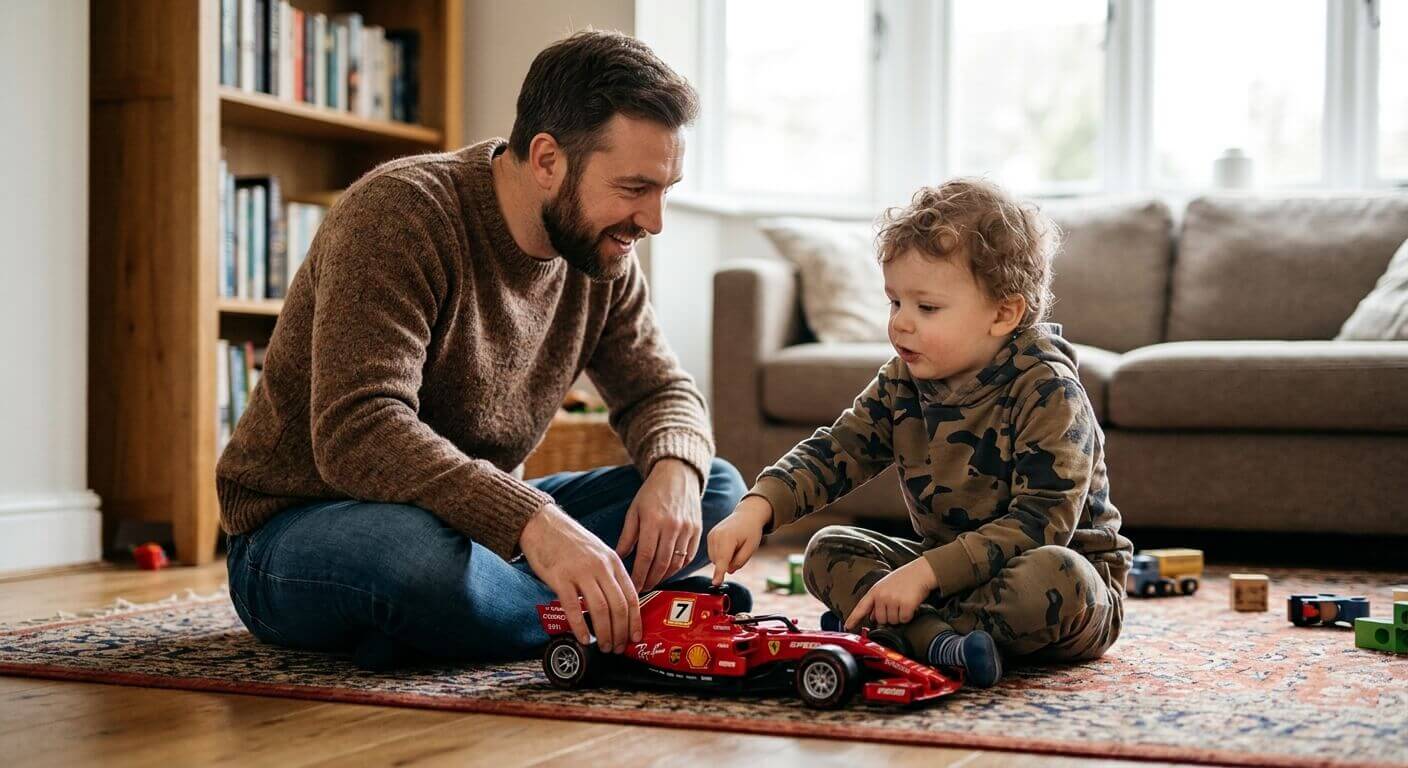
A child is playing with a toy car.
The adult asks:
— What’s this?
— A car.
— What color is it?
— Red.
— And how many wheels does it have?
— Four.
At first glance, a spoken exchange has taken place. But in fact, the child has only answered a series of questions.
Now let’s look at another version.
— You’ve got a red car. It’s going so fast!
— Yes, it’s a race car!
— A race car? Then it needs a track.
— And a garage!
Here the child does more than answer: they suggest their own ideas, develop the topic, and keep the conversation going.
What helps:
- Alternate questions with comments, observations, and your own thoughts.
- Do not turn every game into a knowledge test.
- When your child tells you something on their own, respond to what they said first.
- Share your own impressions: “I like this car”, “I’m surprised it goes so fast”.
- Use exclamations, emotional reactions, and natural pauses.
A useful exercise at home: for five minutes of shared play, try mostly commenting on what your child is doing rather than asking questions.
You may notice that your child starts communicating on their own more often.
4. Expand what your child says
One of the most useful techniques for developing phrase-level speech is language expansion.
The idea is simple: the child says a word or a short phrase, and the adult naturally adds new information to it.
For example:
Child: “Cat”.
Adult: “Yes, that’s a fluffy cat”.
Child: “Cat sleeping”.
Adult: “The cat is sleeping on the couch”.
Child: “Mommy, give”.
Adult: “Mommy, please give me the ball”.
Child: “Car go”.
Adult: “The red car is going fast down the road”.
Child: “I walked”.
Adult: “You went for a walk with Daddy in the park”.
In this way, the child hears new grammatical structures and gradually receives models of more complex speech.
Tips:
- Add one or two meaningful details to what your child says, based on their current abilities.
- Do not require them to repeat the expanded phrase every time.
- Do not interrupt your child to correct grammatical mistakes.
- Respond to the content of the message and model the correct form.
- Expand not only the number of words but also the meaning of what is said.
For example:
Child: “The car stopped”.
Adult: “The car stopped because the light up ahead turned red”.
This is how more complex grammatical structures and an understanding of cause and effect gradually develop.
5. Create opportunities for your child to start communicating
Children need situations in which they are interested in telling you something.
For this, you can use small surprises, unfinished play actions, and opportunities to choose.
Offer choices.
Instead of the general question “Do you want something to eat?”, offer: “Would you like an apple or a banana?”
If your child points to the banana, say: “Banana. You chose the banana”.
Use surprises.
Put a teddy bear inside your child’s shoe.
— Oh, look! Who’s hiding in there?
Your child may laugh, point, comment, or carry on the story themselves.
Pause during familiar games.
— One, two, three…
Child: “Go!”
You can use this technique when launching toy cars, playing with soap bubbles, singing familiar songs, or reciting counting rhymes.
Create opportunities to ask for more.
For example, after you launch a toy car, pause. Your child may say “more”, gesture, make a sound, or ask you to repeat the action in some other way.
An important rule: we create opportunities for communication, not artificial difficulties for the child.
There is no need to hide things your child needs, deliberately ignore requests, or delay help in order to make them talk.
6. Teach your child to carry on a conversation, not just answer
Holding a conversation is more than being able to speak in sentences.
It is the ability to start a conversation, listen to the other person, respond, stay on topic, ask questions, clarify information, and end the exchange.
These skills develop gradually.
Start with turn-taking.
For children who do not yet use extended speech, simple games are helpful:
- rolling a ball back and forth;
- taking turns building a tower;
- taking turns adding to a drawing;
- taking turns feeding a teddy bear;
- taking turns launching toy cars.
This is how a child learns the principle of interaction: now it’s my turn, then it’s yours.
Later, this principle carries over into speech.
For example:
Adult: “I love strawberries. How about you?”
Child: “Bananas”.
Adult: “I love raspberries too. Which berries do you like?”
Teach your child to ask questions in return.
For example:
— How was your day?
— Good.
— My day was really busy. Do you want to know what interesting thing happened?
If it is hard for your child to come up with a question on their own, you can offer a model: “You can ask: ‘What happened?’”
Teach your child to ask for details.
— I saw a very unusual animal today.
Pause.
— What kind?
— A huge dog!

Support the topic your child brings up.
If your child is talking about a dinosaur, do not rush to switch the conversation to colors, numbers, or other educational content.
Instead, ask:
— Which dinosaur is it?
— What could it do?
— Where do you think it lived?
— Why do you like this dinosaur in particular?
At the same time, remember: a conversation is not a sequence of questions. Add your own comments, and share your guesses and impressions.
7. Teach your child to talk about their own experiences
One of the most common questions parents ask is: “Why does my child answer ‘Nothing’ when I ask, ‘What happened at preschool?’”
The reason is not always an unwillingness to talk.
The question “How was your day?” requires a child to recall many events, pick out the main one, organize the information in order, and put it into coherent speech.
For a young child, this can be a difficult task.
So start with specific questions.
Instead of “What happened at preschool?”, try:
— Who did you play with today?
— What was the funniest thing today?
— What game did you play outside?
— Did anything make you sad today?
— What would you like to do again tomorrow?
Use photos.
Look through photos from a walk together and piece together the order of events.
— Where did we go first?
— Who did we meet?
— What did we do next?
— How did it all end?
Start a family ritual: “Three Things from the Day”.
In the evening, each family member talks about three things:
- What did you like today?
- What surprised you?
- What was hard?
It is best for adults to go first and set an example.
For example: “Today I enjoyed our walk. I was surprised when I saw a huge dog. And it was hard because I was very tired”.
Gradually, your child learns to talk not only about events but also about their own emotions and impressions.
8. Read books so that your child becomes part of the conversation
Reading is much more than getting to know a text.
It is a chance to build vocabulary, grammatical structures, an understanding of cause and effect, and the ability to predict, describe, and discuss emotions.
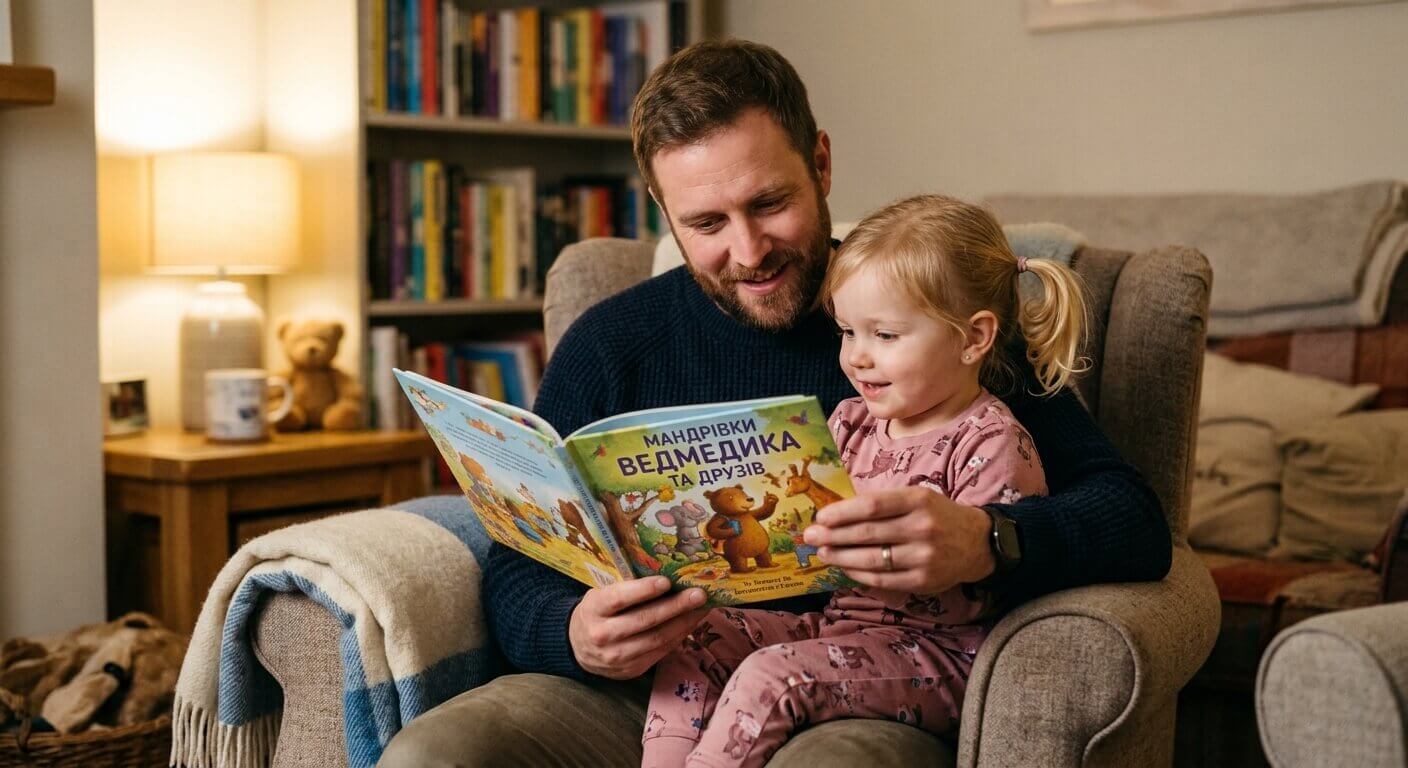
Dialogic reading, in which the adult and child talk about the story together, is especially useful.
For example, in an illustration a bunny is sitting under a tree.
You can begin with a simple question:
— Who’s this?
— A bunny.
Then gradually make the conversation more complex.
— What are its ears like?
— What is the bunny doing?
— Why did it hide under the tree?
— What do you think the bunny will do next?
— What would you do in its place?
It is important not to ask all of these questions in a row. Choose one or two that match your child’s speech abilities and interest.
More tips:
- Let your child choose the book.
- Do not insist on listening to the story to the end if they want to talk about a picture.
- Support their guesses about what will happen next.
- Talk about the characters’ emotions.
- Compare events in the book with your child’s real-life experience.
- Suggest making up a different ending to the story.
- Return to favorite books, gradually adding new words and explanations.
9. Use everyday situations to develop speech
Speech development does not always require special workbooks, teaching materials, or separate time for lessons.
Ordinary everyday situations can be a wonderful opportunity for communication.
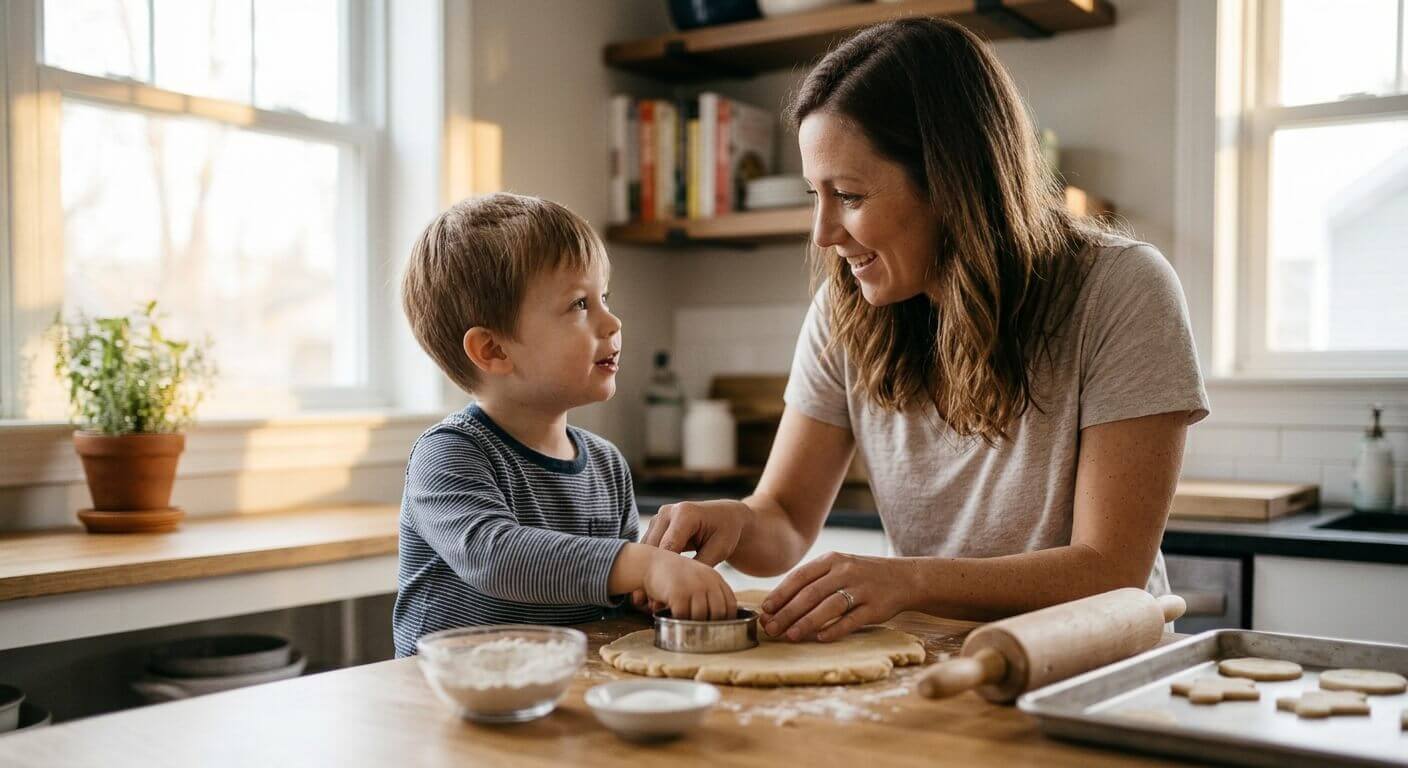
While cooking
Involve your child in simple, safe tasks.
For example, while making cookies, you can talk about:
— What should we do first?
— How does the dough feel?
— Why are we adding flour?
— What will change once the cookies are baked?
Situations like these help children learn the names of actions, the qualities of objects, sequence, and cause and effect.
While getting dressed
Comment on the sequence of actions:
— First we’ll put on socks, then shoes.
— It’s chilly today, so we’ll take a jacket.
— Which sweater do you want to wear, the blue one or the green one?
On a walk
Point out interesting objects, sounds, and events.
You can play “I Spy”.
— I spy something big and green with branches. What is it?
Later, switch roles so your child makes up the riddle.
While shopping
Invite your child to help make a grocery list or find the items you need.
— We need apples. Which ones should we pick?
— How many bananas should we get?
— What else do we need to make a salad?
For children with more developed speech, you can make the task harder:
— Why are we choosing these particular foods?
— What can we make with these ingredients?
10. Enrich your child’s vocabulary with different parts of speech
Parents often focus mainly on teaching nouns — the names of animals, fruits, vehicles, clothes, and household objects.
However, to build complete sentences, a child also needs verbs, adjectives, adverbs, prepositions, and conjunctions.
Build a vocabulary of verbs.
Not only “car”, but also “drives”, “turns”, “brakes”, “passes”, “stops”.
Not only “dog”, but also “runs”, “sniffs”, “jumps”, “hides”, “plays”.
Add words that describe qualities.
For example: “soft”, “rough”, “transparent”, “sticky”, “bitter”, “cool”.
Do not forget comparisons: “taller”, “shorter”, “heavier”, “lighter”, “wider”, “narrower”.
Build a vocabulary of emotions.
Gradually introduce your child not only to the words “happy” and “sad”, but also to “disappointed”, “surprised”, “excited”, “confused”, “proud”, and “worried”.
For example:
— The boy got upset because his toy broke.
— The girl was surprised when she saw the present.
Teach linking words.
Especially important are the words “because”, “first”, “then”, “after that”, “if”, and “although”.
For example:
— We stayed home because it started pouring.
— First we’ll wash our hands, and then we’ll sit down to dinner.
— If it’s sunny tomorrow, we’ll go to the park.
This is how a child gradually learns not only individual words but also the logical connections between events.
Speech develops through everyday communication, not only during lessons. In the next article, we will look at ten games to encourage speech at home, phrases that help children talk, and common mistakes parents make. You will also find a daily plan and learn when it is worth seeing a specialist.
 Taking care of your children,
Speech therapist,
correctional teacher,
founder of the Speech and Correctional Therapy Centers of Oleksandra Zinchenko,
co-founder of the Association of Speech Therapists of Ukraine
More information on the website: https://logocenter-zinchenko.com/