
Games, Helpful Phrases, and a Daily Plan for Parents
This is a continuation of the article “How to Encourage Your Child to Have a Conversation”. Here you will find ten games to get your child talking at home, phrases that help children speak, tips for different speech levels, a daily plan, and signs that it is time to see a specialist.

1. Ten games to encourage speech at home
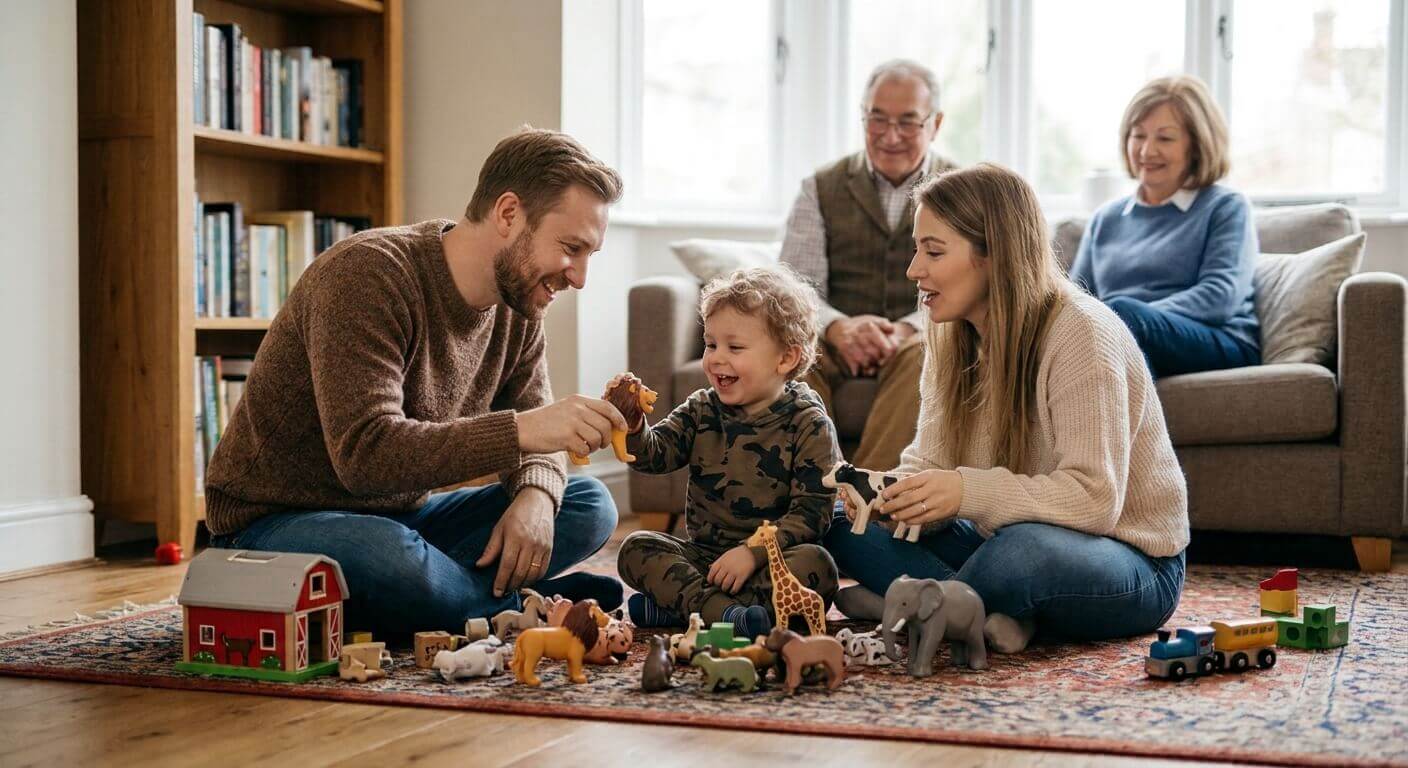
Game 1. “Who’s Doing What?”
Use toys or pictures showing different actions.
For example:
— The teddy bear is sleeping.
— The bunny is jumping.
— The dog is running.
For children who already use sentences, you can make it harder:
— Why did the teddy bear fall asleep?
— Where did the dog run to?
— What will the bunny do next?
This game builds verb vocabulary, grammar, and connected speech.
Game 2. “The Magic Bag”
Put a few familiar objects in an opaque bag.
Your child pulls out an object and talks about it.
You can discuss its name, color, shape, properties, and purpose.
For children at an early stage of speech, the adult names the object and models a short phrase.
Game 3. “What Happened First?”
Use sets of three or four story pictures.
For example: a boy planted a seed, watered it, a sprout appeared, a flower grew.
Invite your child to put the pictures in the right order and tell the story.
This helps develop connected speech, sequencing, and logical thinking.
Game 4. “The Store”
Set up a small store at home with groceries or toys.
Act out buying and selling.
— Hello!
— What would you like to buy?
— Two apples, please.
— Here are your apples.
— Thank you!
Switch the roles of customer and shopkeeper.
Game 5. “Toy Doctor”
Use stuffed animals and a toy doctor’s kit.
Talk about:
— What happened to the teddy bear?
— Where does it hurt?
— How can we help?
— What should we do first?
This game develops conversational speech and the ability to explain a sequence of actions.
Game 6. “Photo Stories”
Look through family photos.
Recall who is in them, what was happening, and what emotions you felt.
If needed, help your child begin the story.
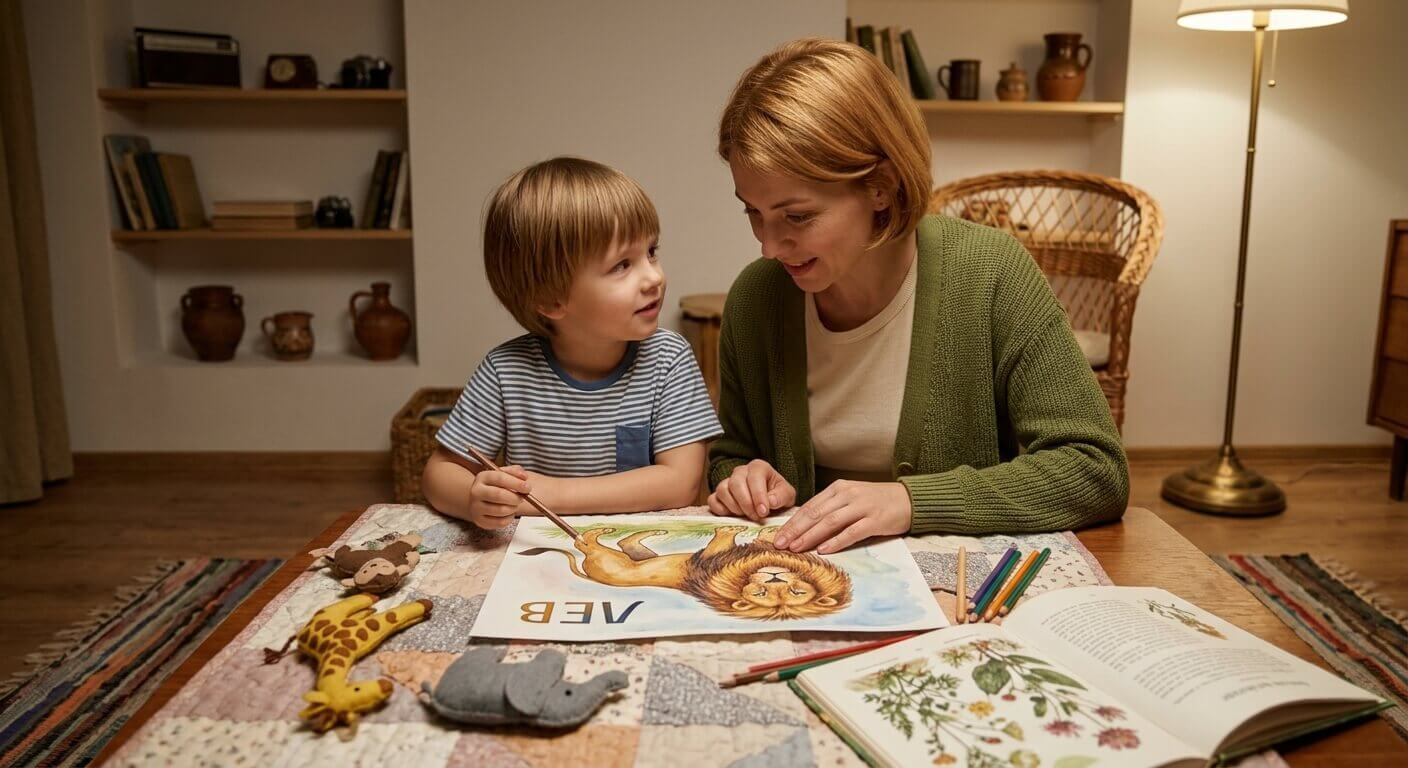
Game 7. “Invent a Strange Animal”
Draw a fantastical creature.
Invite your child to come up with its name, where it lives, its favorite food, special powers, and adventures.
This game develops imagination, vocabulary, and creative speech.
Game 8. “Builders”
Use a construction set or blocks.
The adult gives spoken instructions:
— Put the red block under the blue one.
— Place the small block next to the big one.
— Build a tower to the right of the house.
Then switch roles: let your child give you instructions.
Game 9. “Puppet Theater”
Use toys, dolls, or finger puppets.
The characters can meet each other, ask for help, invite each other over, quarrel, and make up.
This gives your child a chance to practice different social situations and speech patterns.
Game 10. “Again!”
Use soap bubbles, a spinning top, toy cars, or other toys with fun, repeatable actions.
After the action, make a natural pause.
Your child may ask for more with the word “more”, a gesture, a sound, or another way available to them.
Respond to their initiative and repeat the action.
The goal of this game is to help your child understand that communication can influence what happens.
2. Which parent phrases help develop speech?
Sometimes changing a familiar phrase is enough to give a child more opportunities to communicate.
- Instead of “Say it properly!”, try: “I’m listening. Show me or tell me what you want”.
- Instead of “Repeat after me!” — “Look, it’s a bus. A big bus is going by”.
- Instead of constantly asking “What’s this?” — “I see a little puppy. It’s running”.
- Instead of “How was your day?” — “Who did you play with today?”
- Instead of “You said that wrong!” — repeat what they said in the correct form.
- Instead of “Don’t interrupt!” — “I’ll finish my thought, and then I’ll listen to you”.
- Instead of “Don’t you have anything to say?” — “We can think about it together. I’ll start”.
- Instead of “Stop making things up!” — “What an interesting story! What happened next?” if your child is telling a made-up story.
It matters to a child to feel that an adult cares not only about whether their speech is correct, but above all about what they want to say.
3. What should parents avoid?
Even the best intentions can sometimes reduce a child’s motivation to communicate.
Do not constantly demand repetition.
Endless “say it”, “repeat”, “one more time” can turn communication into an unpleasant chore.
Do not correct every mistake.
It is often more effective to repeat what your child said in the correct form than to stop them and demand a correction.
Do not ask too many questions.
A conversation should involve an exchange of thoughts, not just a knowledge check.
Do not compare your child with others.
Comparisons do not help build speech skills. It is important to assess your child’s individual development with age-based milestones in mind.
Do not insist on speaking out loud at all costs.
Gestures, pointing, pictures, and augmentative and alternative communication tools are full-fledged ways of communicating. Using alternative communication does not hinder the development of spoken language and may in fact support it.
Do not replace live interaction with gadgets.
Even educational content cannot fully replace direct interaction with an adult.
Do not hold activities when your child is overtired.
If your child is hungry, exhausted, or emotionally overloaded, take care of how they are feeling first.
4. How to adapt these tips to your child’s speech level?
It is important to go not only by chronological age, but also by your child’s current speech and communication abilities.
If your child mainly uses gestures, sounds, or single words
The main focus should be on developing joint attention, communicative initiative, understanding of spoken language, and imitation of actions and sounds your child can manage.
Use short utterances:
— The ball is rolling.
— More bubbles!
— Mommy’s here.
Add gestures, natural pauses, and emotional reactions.
If your child speaks in short phrases
The main focus is on expanding word combinations, building verb vocabulary, and learning the qualities of objects and simple grammatical structures.
For example, if your child says “Daddy car”, the adult might reply: “Yes, Daddy’s car is here”.
If your child speaks in sentences but rarely starts conversations
Focus on developing communicative initiative, turn-taking, and the ability to ask questions and stay on topic.
Role-play, family conversations, talking about your child’s interests, and activities that involve asking for details are all helpful.
If your child uses sentences but has difficulty telling connected stories
The main focus is on sequencing, cause and effect, retelling, and making up stories independently.
Use sets of story pictures, photo stories, and conversations about books and events from your own lives.
Help your child with anchor words: “first”, “then”, “because”, “in the end”.
5. A daily speech plan for parents
There is no need to turn the whole day into a lesson.
It is far more useful to build short moments of quality interaction into your family’s usual rhythm.
Morning. At breakfast, offer your child choices, talk about plans for the day, and name foods and actions.
On the way to preschool or on a walk. Point out what is going on around you, comment on what you see, and play word riddles.
After coming home. Give your child time to rest, and then talk about one or two specific events from the day.
Playing together. Set aside at least 10–15 minutes for quality interaction in which you follow your child’s interest. This is a practical guideline, not a mandatory rule.
Evening. Read a book, talk about the pictures, recall the events of the day, or act out a short story with toys.
What matters most is regularity, naturalness, and enjoying communication.
6. When is support at home not enough?
A child’s speech activity depends on many factors: hearing, understanding of speech, communication development, cognitive characteristics, sensory needs, and overall health.
Interaction at home is an important part of support, but it does not replace a professional assessment and individual intervention if they are needed.
It is worth consulting a speech-language therapist or another appropriate child development specialist if:
- your child rarely initiates communication or has difficulty with shared interaction;
- their speech is developing more slowly than age-based milestones;
- it is hard for your child to understand simple requests or instructions appropriate for their age;
- at two years old, your child does not yet combine at least two words into simple phrases;
- at three years old, it is hard for your child to keep up a simple conversation with two back-and-forth exchanges;
- your child has lost words or communication skills they used before.
If a speech delay is suspected, it is also advisable to have your child’s hearing checked, even if they seem to respond well to ordinary household sounds.
You do not need to wait until a certain age to seek advice if you are concerned about your child’s speech development.

It is especially important not to delay if your child has lost skills they previously had.
Speech does not develop simply because a child repeats words after an adult many times.
It develops through meaningful interaction, when words take on meaning, when the desire to communicate appears, and when an adult hears the child’s initiative and helps them take the next step.
Sometimes that step will be a first gesture to ask for something. Sometimes it will be a first word said independently. For another child, it may be a five-word sentence, a clarifying question, or a short story about their day.
It is important to see these changes, support them, and not compare your child with others.
The best language environment is not one in which a child is constantly asked questions. It is one in which there is always room for their thoughts, initiatives, emotions, and words.
Parents do not need to become speech therapists for their own children. But they can be the most important partners in the daily development of communication.
After all, a child learns to communicate not when they are constantly asked to say something, but when they feel that someone wants to hear them.
And that is where real conversation begins.

Speech therapist,
correctional teacher,
founder of the Speech and Correctional Therapy Centers